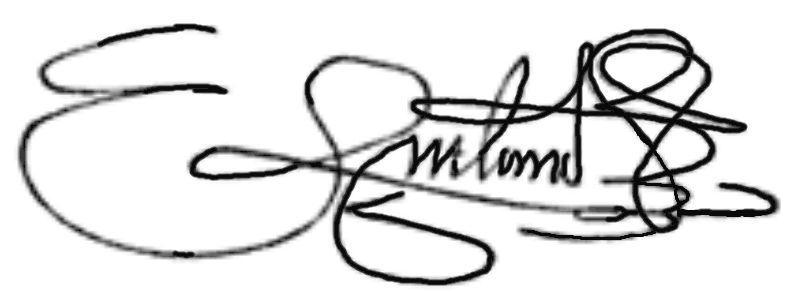
Edward MANNERS
(3rd E. Rutland)
|
Born: 12 Jul 1549 Died: 14 Apr 1587, Puddle Wharf, London, England Buried: St. Mary the Virgin Church, Bottesford, Leicesterhire, England Notes: Knight of the Garter. 15°B. Ros Father: Henry MANNERS (2° E. Rutland) Mother: Margaret NEVILLE (C. Rutland) |
.gif) |
Married: Isabel HOLCROFT (C. Rutland) (b. 1555 - d. 16 Jan 1606) (dau. of Sir Thomas Holcroft and Julianne Jennings) 6 Jun 1573
Children:
01.jpg)
Detail of the portrait of Edward Manners, 3° Earl of Rutland
at Belvoir Castle
| Born in 1549, was eldest son of Henry,
second Earl of Rutland, by
Margaret, fourth daughter of
Ralph, Earl of Westmoreland. He seems to have been educated at
Oxford, though he did not graduate there as a student. He bore the title of Lord
Roos or Ros, the old title of his family, until 1563, when by the death of his
father he became third Earl of Rutland. He was made one of the
Queen’s
wards, and was specially under the charge of Sir
William Cecil, who was connected with him by marriage. He
accompanied the
Queen on her visit to Cambridge in 1564, and was lodged in St. John’College, and created M.A. 10 Aug. In Oct 1566 he was made M.A. of
Oxford. In 1569, at 20 years of age and in ward to her majesty, he joined the Earl of Sussex, then lieutenant - general of her majesty’s forces, taking his tenants with him, and held a command in the army which suppressed the northern insurrection against the earls of Northumberland and Westmoreland. Edward was made lieutenant as also coronel of foot. In 1570 he passed into France, Cecil drawing up a paper of instructions for his guidance. He was in Paris in the Feb of the next year. At home he received many offices, and displayed enthusiastic devotion to the Queen. On 5 Aug 1570 he became constable of Nottingham Castle, and steward, keeper, warden, and chief justice of Sherwood Forest; in 1571 he was feodary of the duchy of Lancaster for the counties of Nottingham and Derby; in 1574 he was appointed lord-lieutenant of Nottinghamshire. Between the 1st and the 3 May 1571, Sir George Delves was one of the defenders in a tournament before the Queen at which one of the challengers was the Earl of Oxford. On 24 Jun, Delves wrote to the Earl of Rutland "There is no man of life and agility in every respect in the Court but the Earl of Oxford". In a letter from court in 1571 Delves mentions Isabel Holcroft, dau. of Sir Thomas Holcroft and Julianne Jennings, the Earl’s future wife, whom he may have been courting on Rutland’s behalf. On Jun 1577 Rutland was placed on the ecclesiastical commission for the province of York, and in 1579 on the council of the north. In the grand tilting match of 1580 Rutland and twelve others contended with a similar number, headed by Essex, before the queen at Westminster. His public offices probably now absorbed all his time, as in 1581 a relative, John Manners, seems to have been managing his estate. On 23 Apr 1584 he became K.G., and on 14 Jun 1585 lord-lieutenant of Lincolnshire. From the 1580s a bitter quarrel with Thomas Markham of Ollerton, over the fees and profits Markham had taken as ‘steward, keeper, warden and chief justice’ of Sherwood forest during Rutland’s minority. Markham had been a servant in the second Earl’s household. In the end the Queen heard the opinion of the judges, but took the case into her own hands, so that ‘her old servant’ Markham should enjoy his privileges and fees ‘according to her free gift and meaning, which she is best able to expound’. The disputes continued, however, with successive earls of Rutland, until at least 1597. After negotiations with several other ladies like Frances Howard (dau. of William, lord Howard of Effingham, later Countess of Hertford) and Elizabeth Hastings (dau. of Francis, second Earl of Huntingdon, later Countess of Worcester), he married (later than Jan 1571-2) Isabel, daughter of Sir Thomas Holcroft of Vale Royal, Cheshire. Isabel was a maid of honor to Queen Elizabeth. His style of living was very expensive; when he went with his countess to London about 1586 he had with him forty-one servants, including a chaplain, trumpeter, gardener, and apothecary. In Jun 1586 a commission was directed from Queen
Elizabeth, leading to the ratification of a firm league of amity
between her majesty and James the Sixth King of Scotland at Berwick. “This
league was articulated, and commissioners thereto appointed; the right
honourable Edward earle of Rutland (a complet nobleman, answerable to the etymon
of his name, and verie well deserving the poet’s report, On 6 Oct he was one of the commissioners to try Mary Queen of Scots. Camden relates, that the Queen
promised to make him Lord Chancellor after the death of
Sir Thomas Bromley,
which took place 12 Apr 1587, and he was for a day or two so styled. He died,
however, on 14 Apr 1587. Camdem says that he was “being a profound lawyer,
and a man accomplished with all polite learning.” Eller gives an account of his will, dated Nov 20, 1583, and evidently dictated by himself. That the character here given of him is just, seems comfirmed by the preamble to this last will: “Forasmuch as it is decreed by the eternal judgement of Almighty God, that all creatures must and shall dye; and as nothing is more certain than death, so there is nothing more incertain than the time and place, which God hath only reserved to his own prudence, to the end we should by his grace and mercy direct the course of our life in such as we might always be found ready and well prepared to die whensoever it shall be his pleasure to call us of this life: Therefore I Edward Earl of Rutland, calling to my remembrance that it is not the least duty of a Christian man, knowing this uncertainty of life, to take order whilst he is in best health for the goos disposition of his lands and hereditaments, and likewife of his goods and chattels as it shall please God to make him owner of, as well for the discharge of his own conscience, as for the preventing of such troubles, unkindnest, and controverties, as do most commonly grow when no such order is taken; do, this day and year abovewritten,” &c. After solemnly recommending his soul to God, he bequeaths his body to be buried in the parish church of Bottesford, with his ancestors; and directs 100 £ at least to be laid out on his tomb; “the funeral to be in such a decent order as to the estate and calling it hath pleased God to call me to appertain, with liberality especially to the poor.” And confidering that the barony of Ros, for want of heirs male of his body, was to descend to his heir general; for that one of his ancestors, whose heir he was, did marry the heir of the lord Ros; and thereby enjoyed that title and dignity, as descended on the part of the mother; as also continued the same until their creation to this earldom of Rutland. Supposing therefore style and dignity of the faid barony not to be utterly extinguished, but to remain suspended, because the earldom of Rutland was entailed to the heir male of Thomas, his grandfather; and that the said barony was descendable to the heirs general; he settled his estate, as that both honours might properly be supported. To his wife, the lady Isabel, he gave “600 good wethers, 500 good ewes, all his jewels, all the garments and apparel made for the faid lady Isabel, all his coach-horses, litter horses, with coach and litter, and the furniture thereos, and twelve yomans geldings, to be taken at her discretion.” He gave also one half of his plate, brass, pewter, bedding, sheets, hangings, and other implements of furniture, and of all his corn and grain; the other half to the next heir of his grandfather Thomas Earl of Rutland. He made his brother John Manners, esq; full and sole executor; and constituted his three uncles, John Manners, Roger Manners, and Sir Thomas Manners, Knight, with George Chaworth, esq; supervisor of his will. And by a codicil, dated 14 Apr 1587, being “sick of body, but yet of good and perfect remembrance,” he recognized and confirmed his former will; and died the same day at his house near Puddle Wharf, in London. The will was proved Dec 1, 1587. His funeral was very costly; his body was taken to Bottesford, Leicestershire, and buried in the church, where there is an epitaph. The widow, who lived till 1606, was troubled with money difficulties
owing to her husband’s debts, and engaged in litigation about his will. By
Isabel he left
one daughter and sole heiress,
named Elizabeth; who, in right of her father, became baroness Ros, and,
at the age of thirteen, married William Cecil, esq; eldest son of Sir
Thomas Cecil, knight, eldest son to
lord Burghley, afterwards Earl of Exeter. This lady died at the house of
her grandfather Sir
Thomas Holcroft, in Tower-street, London, Apr 12,
1591; and was buried in the chapel of St. Nicholas in Westminster Abbey; where a
monument was erected for her on the West side of the chapel, of which Mr. Dart
has given a slight sketch; and which he describes as situated “on the West
side of the chapel, seemingly very ancient by the white spongy stone whereos it
is made, on which is the image of lady veiled, and leaning on her left arm. The
monument,” he adds, “hath no inscription; but, as appears by the arms
and the heralds register, was erected to the lady Elizabeth, commonly called the
lady Ros.” This lady left an only son, William, not quite a year
old, who, at his mother’s funeral, was proclaimed, after the service in the
church, by the title of “lord Rod, of Hamlake, Trusbut, and Belvoir;”
and afterwards, in the reign of King James, claimed those baronies, in
right of his mother, against Francis
Earl of Rutland; when the King determined that he should be lord Ros
of Holderness, and have the ancient seat of the lords Ros in paliament; but that
title of lord Ros of Hamlake, Trusbut, and Belvoir, should still remain to the
Earl of Rutland. The lord Ros of Holderness was sent Ambassador to the
Emperor
Matthias, in Spain, whence he returned the next year; and in 1618, having
traveled into Italy, he died, without issue, at Naples, not without suspicion of
being poisoned. On his death, the title of lord Ros reverted indisputably to the
Rutland family. |
03.jpg)
Tomb of the Earl and his wife at Bottesford |
.jpg)
Edward Manners, 3rd Earl of Rutland, c.1675 (oil on canvas) by Jeremias van der Eyden |
02.jpg)
Tomb of the Earl and his wife at Bottesford |
 to Bios
Page
to Bios
Page |
|
 to Peerage Page
|
 to Home Page
 |
