03.jpg)
02.jpg)
Henry HOWARD
(1st E. Northampton)
Born: ABT 24 Feb 1540, Shottesham, Norfolk
Died: 15/16 Jun 1614, Northampton House, The Strand
Buried: Dover Castle
Notes: Knight of the Garter. Baron of Marnhull
Father: Henry HOWARD (E. Surrey)
Mother: Frances De VERE (C. Surrey)
Roman Catholic intriguer during the reigns of Elizabeth I and James I of England, known for his unscrupulousness and treachery.
Born near Ipswich at Shottesham, he was the second son of the poet Henry Howard, Earl of Surrey, and his wife, lady Frances de Vere, and the younger brother of Thomas Howard, fourth Duke of Norfolk.
When John White, Bishop of Lincoln, replaced his old tutor, John Foxe, Sir Henry took an instant liking to the Bishop, an ardent Catholic. And when the Bishop removed to Winchester in 1556, Sir Henry went with him. There Sir Henry studied philosophy, civil law, divinity, and history, and seems to have acquired a strong sympathy with Roman Catholicism.
On the death of Queen Mary, and the accession of her half sister, Queen Elizabeth, the Catholic clergy were stripped of their titles. Bishop White found himself deprived of his bishopric, and Queen Elizabeth undertook supervision of Sir Henry's education.
At the Queen's expense, he proceeded to King's College, Cambridge, where he graduated M.A., in 1564. He afterwards joined Trinity Hall, earned the reputation as a fine scholar. His interests were varied and were not limited to intellectual pursuits. He enjoyed music and learned from a master to play the lute.
Having little money and conscious that he was living 'beneath the compass of his birth,' he came to court about 1570. But his brother, Thomas, was in hot water and Sir Henry found his prospects of a brilliant life at court were dim.
After discovery of his brother's plot to wed Mary, Queen of Scots, and of his own correspondence with her, he was arrested more than once on suspicion of harbouring treasonable designs. After repeated examinations, he established his innocence to Queen Elizabeth's satisfaction. He was readmitted to court and granted a yearly pension. This reprieve, however, came with a terribly price; for the rest of his life he would be suspected of giving evidence against his brother in exchange for his freedom.
After his brother's execution, Sir Henry retired to Audley End, and directed the education of his brother's children.
He had established a close relationship with Mary, Queen of Scots. This was a dangerous liaison. He desperately tried to assure Queen Elizabeth, who was dreadfully suspicious of the friendship. He attempted to assure Elizabeth that he merely supplied her with political information and that he gave her the prudent advice to "abate the sails of her royal pride".
It was his bad luck to have a violent quarrel with his kinsman, Edward de Vere, 17th Earl of Oxford, and De Vere, seeking revenge, fanned the flames of suspicion and convinced the Queen that Sir Henry was guilty of heresy and of having treasonable correspondence with the Scottish Queen.
Sir Henry was once more arrested and defended himself at length in a letter to Elizabeth in which he admitted that he had taken part in a Roman Catholic worship because of conscientious difficulties "in sacramentary points," but declared that it was ridiculous to believe that "so mean a man" as he could win Queen Mary's "liking".
|
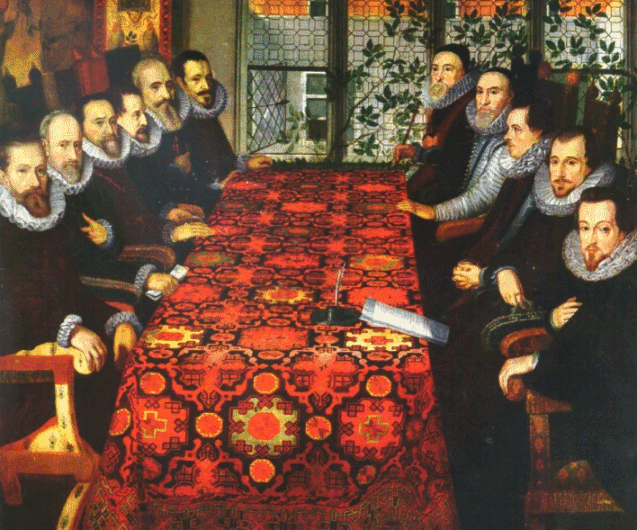
The Somerset House Conference, 1604
(Juan de Velasco Frias; Juan de Tassis, Count of Villa Mediana; Alessandro
Robida; Charles de Ligne, Count of Aremberg; Jean Richardot; Louis
Vereyken; Thomas Sackville, Earl of Dorset; Charles Howard, Earl of Nottingham,
Henry Howard, Earl of Northampton; Charles Blount, Earl of Devonshire and
Robert Cecil, Earl of Salisbury)
Detail of The Somerset House Conference |
His convoluted defense worked, however, and he was soon free. He wisely left court and retired to St. Albans and spent a year writing "Preservative against the Poison of supposed Prophecies," an attack on judicial astrology. The book, published in 1583, was revised and reissued in 1621, was suspected of containing veiled references which could be interpreted as treason, and Sir Henry was sent to Fleet Prison. It was whispered that Queen Mary had sent him a ring with a message that she "did repute him as his brother". His luck held out, and he was released, but he soon found that his questionable reputation made him something of a pariah, a "papist and a Spaniard", and found himself without any means livelihood. At the close of the reign of Queen Elizabeth I, he joined with Robert Cecil in courting the heir to the throne in Scotland, the main object of his long letters of advice being to poison King James VI's mind against Sir Walter Raleigh and other rivals, whom he at the same time hoped to ensnare into compromising relations and correspondence with Spain. These methods, which could not influence Elizabeth, were completely successful with James, and on the latter's accession Howard received a multitude of favours. In 1603 he was made a privy councillor, and in 1604 he was made lord warden of the Cinque Ports and Earl of Northampton and Baron Howard of Marnhull in Dorset. He was one of the judges at the trials of Raleigh and Lord Cobham in 1603, of Guy Fawkes in 1605, and of Garnet in 1606, in each case pressing for a conviction. The climax of his career was reached when he assisted his grandniece, Frances Howard, Lady Essex, daughter of Thomas Howard, first Earl of Suffolk, and his pretty wife Catherine Knyvett, in obtaining her divorce from her husband, Robert Devereux, third Earl of Essex, in order to marry the favourite Robert Carr, Earl of Somerset, whose mistress she already was and whose alliance Northampton was eager to secure for himself. He obtained the divorce by the decree of a special commission, and when Sir Thomas Overbury's influence seemed likely to prevent Somerset from completing the marriage project, he caused Overbury to be imprisoned in the Tower of London. Shortly afterward Overbury died from the effects of poison administered according to the wishes of Lady Essex; and the close intimacy which existed between Lady Essex and Northampton leaves his name tarnished with suspicion. He advised against the summoning of Parliament in 1614 and then fomented disputes to compel James to dissolve it. |
Perhaps not the must sensitive politician, he found himself competing with Prince Charles for the Chancellorship of Cambridge University. His wealth and learning seem to have easily secured his election. A tad bit late, he realized that King James resented the university's action, and he immediately resigned. He spent the next few months convincing the King he meant no disrespect to the royal family. A master at suppleness and flattery, he not only succeeded but was reappointed to the Chancellorship at a new election.
He continued a favorite at court and spent the rest of his life fully immersed in the endless and traitorous intrigues. Despite his lack of principles, Sir Henry was a brilliant and versatile talent. A witty and charming man, he was acknowledged as the most learned nobleman of his day. His taste in architecture is evidenced by his enlargement of Greenwich Castle, and by the magnificence of his London resident, now known as Northumberland House. He planned and endowed three hospitals, one at Clun, Shropshire, a second at Castle Rising, County Norfolk, and a third at Greenwich, called Norfolk College. He personally laid the foundation stone of Greenwich College.
He died unmarried, a Roman Catholic, in 1614, following an unskillful operation and was buried first in the chapel of Dover Castle and later, in 1696, removed to the chapel of Greenwich College by the Mercers' Company. His title became extinct.
 to Bios Page
 |
|
 to Peerage Page
 |
 to Home Page
 |
.jpg)
