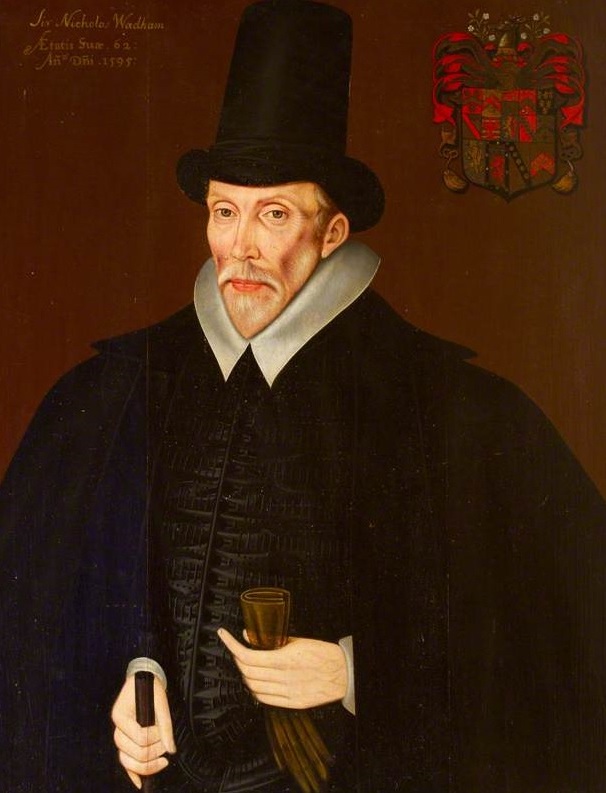
Sir Nicholas WADHAM of Merrifield
Born: 1532, Merifield, Somerset, England
Died: 20 Oct 1609, Merifield, Somerset, England
Buried: 20 Dec 1609, St. Mary's, Ilminster, Somerset, England
Father: John WADHAM of Merifield (Sir)
Mother: Joan TREGARTHEN
Married: Dorothy PETRE 3 Sep 1555, St. Botolph's, Aldersgate St., London, England
Born in 1532, was the only surviving son of John Wadham (d. 1577), and his wife Joan, daughter and coheir of John Tregarthin of Cornwall. His sister Jane married Sir Giles Strangeways. The family originally came and took its name from Wadham or Wadeham in the parish of Knowstone, North Devonshire, where it was settled in the reign of Edward I. Thence it migrated to Egge or Edge, near Seaton in the same county.
Edge was the seat of John Wadham d. 1411, who was appointed a judge of the common pleas in or about 1388. He seems to have been dismissed or resigned in 1397, but survived until 1411. His son, Sir William Wadham, sheriff of Devonshire in 1438, was great-grandfather of Sir Nicholas Wadham (d. 1541), captain of the Isle of Wight, Sheriff of Wiltshire, vice-admiral to the Earl of Surrey in 1522-3, and knight of the shire for Somerset during the Reformation parliament, 1529-34; he married as his second wife Margaret, aunt of Queen Jane Seymour and the Protector Somerset. His eldest son by his first wife was John, father of Nicholas. Nicholas is said to have been educated at Corpus Christi College, Oxford, but his name does not occur in either the college or the university registers. On 3 Sep 1555 he married, at St.Botolph's, Aldersgate Street, London, Dorothy (b. 1534), elder daughter of Sir William Petre, by his first wife, Gertrude, daughter of Sir John Tyrrell. Wadham then retired to his seat at Merefield, where he resided the remainder of his life, dispensing lavish hospitality. He avoided politics, and apparently took little share in local affairs; he was, however, on 21 Apr 1586 added to the commission for the restraint of grain and victuals in Somerset (Acts of the Privy Council, xiv. 70).
|
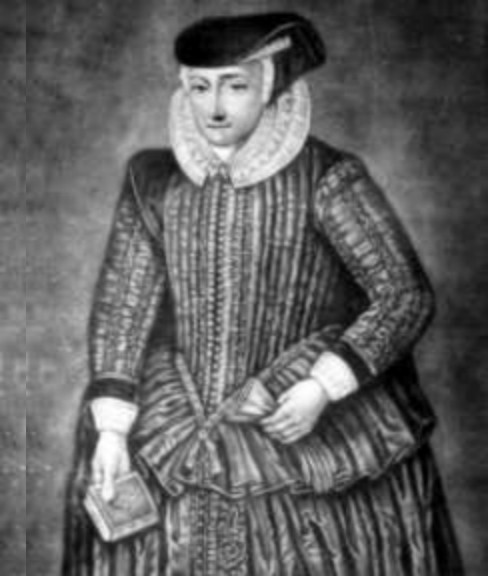
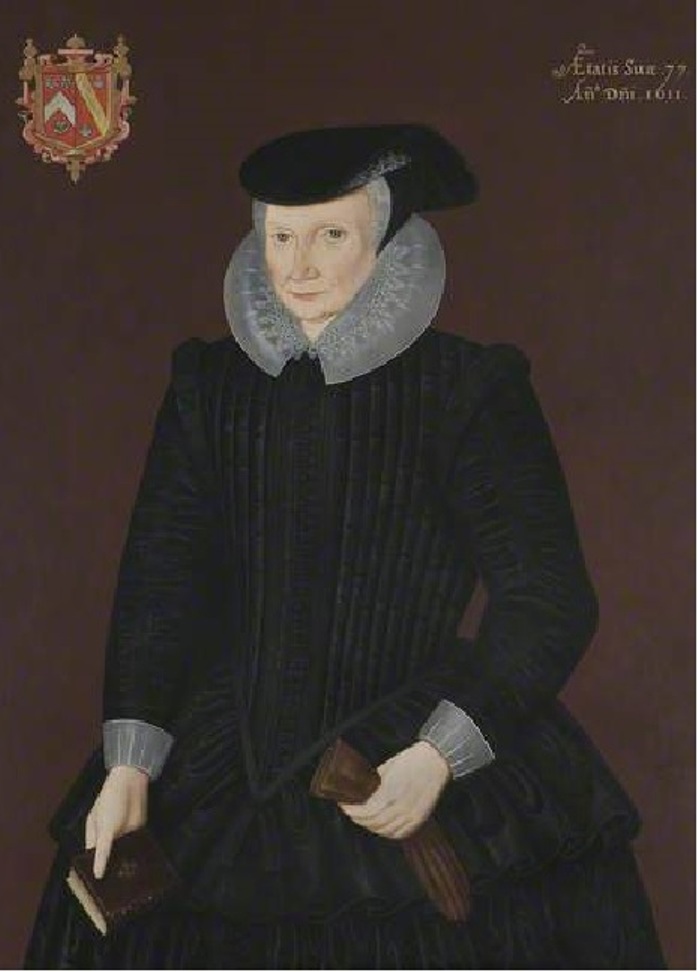
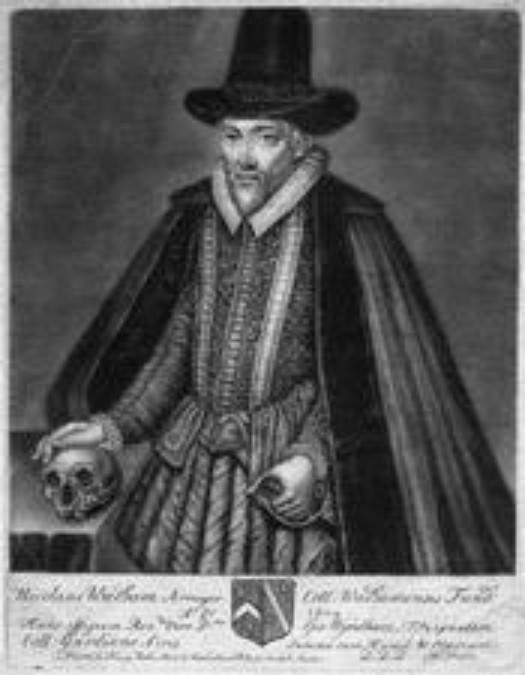
His estates were worth three thousand pounds a year in the currency of the period, and out of this income he saved fourteen thousand pounds, which he determined to spend on charitable purposes, having no children, and his inherited property devolving on his nephews, Sir John Strangways and Sir William Wyndham, father of Wadham Wyndham. In 1606 he founded an almshouse for eight poor people at Ilton, but the bulk of his savings was to be devoted to educational purposes. His original idea is said to have been to establish a college at Venice for the education of English Roman Catholics. The reason for this intention was his alleged adherence to the Roman Catholic faith, but this is inconsistent with the Anglican tone of his statutes for Wadham College, and in any case the foundation at Venice would have been illegal. Ultimately Wadham determined to found a college at Oxford, and he drew up statutes for the proposed establishment. These anticipated some modern reforms by providing that fellowships should be tenable only for a certain number of years, and that neither for them nor for the wardenship should holy orders be a necessary qualification. But before any steps were taken to acquire a site, Wadham died at Merefield on 20 Oct 1609, and was buried in Ilminster church, where he is commemorated by a monument and brass; his portrait, painted in 1595, hangs in the warden's lodgings at Wadham College. His plans were at once taken up by his widow, Dorothy, in spite of her predilection for the Roman Catholic faith, which she shared with the rest of her family. She had enough money (£19,200 from her husband and an additional £7270 of her own). Negotiations were entered into, according to Wadham's instructions, with a view to purchasing the site of Gloucester Hall; they fell through because the principal stipulated that he should be head of the new institution. Wadham had wished that application should next be made to Jesus College, which does not seem to have been done, and the site of the priory of the Austin friars was purchased for six hundred pounds from the corporation of Oxford on 6 Mar 1609-10. The building of the present Wadham College was begun on this site in the following Apr, and it was completed in Jul 1613. Contrary to Wadham's intention, the warden was required to graduate D.D. within a year of his appointment. Dorothy Wadham died at Edge on 16 May 1618, and was buried with her husband in Ilminster church, where she is commemorated by a brass and monumental inscription. Her portrait, painted, like that of her husband, in 1595, hangs in the warden's lodgings at Wadham College; both were mezzotinted by Faber, and are reproduced in Mr. T. G. Jackson's Wadham College, 1892. |
Dorothy Petre by a follower of Custodis c. 1594
Dorothy Petre at Wadham College |
Sources:
Cal. State Papers
Egerton Papers (Camden Soc.)
Wood's Hist. et Antiqq.
Fuller's Worthies
Prince's Worthies of Devon
Granger's Biogr. Hist.
Chalmers's Biogr. Dict.
Clark's Colleges of Oxford
Gardiner's Reg. of Wadham College
W. H. Rogers's Memorials of the West
Collins's Peerage
J. J. Howard's
Collections on Catholic Families
 to Bios Page
 |